Introduction: A New Dawn in Computational Power
The world of technology is currently witnessing a revolution that promises to redefine the very limits of computation. For decades, the steady march of progress, encapsulated by Moore’s Law, has been powered by classical computers that process information as binary bits—0s and 1s. But we are now approaching the physical boundaries of this paradigm. Enter the quantum computer, a machine that leverages the bizarre and counterintuitive laws of quantum mechanics to solve problems deemed impossible for even the most powerful supercomputers today. Recently, a significant milestone was achieved that sent ripples through the scientific community: a quantum computer has smashed a previous performance record, not merely by a marginal improvement, but by a staggering order of magnitude. This article provides a comprehensive deep dive into this breakthrough, explaining the fundamental science, detailing the new record, exploring its practical implications, and charting the future course of this transformative technology.
A. The Quantum Foundation: Beyond the Binary Bit
To appreciate the magnitude of this record-breaking achievement, one must first understand the fundamental unit of quantum information: the quantum bit, or qubit. This is not merely a more advanced version of a classical bit; it is a conceptual leap into a new realm of physics.
A. Superposition: The Power of Being in Multiple States at Once
A classical bit is like a coin that is either heads (1) or tails (0). A qubit, however, is like a spinning coin. While it is spinning, it is not just heads or tails, but exists in a probabilistic blend of both states simultaneously. This phenomenon is known as superposition. It is this property that allows a quantum computer to explore a vast number of possibilities in parallel. While 2 classical bits can represent one of four states (00, 01, 10, 11) at any given time, 2 qubits can represent all four states at the same time. This parallelism grows exponentially; 300 qubits in superposition could represent more states than there are atoms in the known universe.
B. Entanglement: A “Spooky” Connection
Another cornerstone of quantum computing is entanglement, a phenomenon Einstein famously referred to as “spooky action at a distance.” When qubits become entangled, they form a deeply connected system. The state of one qubit is instantly correlated with the state of another, no matter how far apart they are. Measuring one entangled qubit immediately determines the state of its partner. This allows quantum computers to perform complex, correlated calculations with a level of efficiency that is unattainable for classical machines.
C. Quantum Interference: Guiding the Computation
Finally, quantum algorithms are carefully designed to use quantum interference. This involves manipulating the probabilities of different computational paths. Like waves in the ocean, some paths are amplified (constructive interference) while others are canceled out (destructive interference). This guides the quantum system toward the correct answer to a problem, effectively sifting through the massive number of possibilities in superposition to find the optimal solution.
B. Deconstructing the Record-Breaking Achievement
The recent headline-making record is multifaceted. It is not just about raw qubit count, but a more holistic measure of a quantum computer’s power, encompassing stability, speed, and accuracy.
A. The Quantum Volume Metric: A Holistic Benchmark
Simply adding more qubits is not enough. Many are unstable and prone to error. Therefore, the industry has developed a benchmark called Quantum Volume (QV). Quantum Volume is a single number that measures the overall computational power of a quantum computer by considering the number of qubits, their connectivity (how well they can interact), and their error rates. A higher QV indicates a more powerful and reliable machine. The recent record involves a monumental leap in Quantum Volume, demonstrating not just more qubits, but better qubits.
B. The Specifics of the Breakthrough
While several companies are in a tight race, the record-breaking achievement is characterized by several key advancements:
*   **Unprecedented Qubit Count with Low Error Rates:** A processor was unveiled with a significantly higher number of high-fidelity qubits. The critical factor here is that these qubits maintain their quantum state (coherence) for longer periods and have significantly reduced error rates during operations (gates), making complex calculations feasible for the first time.
*   **Advanced Qubit Connectivity:** Previous architectures often had limited connections between qubits, forcing long sequences of operations to move information around. The new record-breaking processor features enhanced connectivity, such as a heavier-hex lattice or all-to-all coupling in trapped-ion systems, allowing for more efficient and powerful algorithms.
*   **Dynamic Circuit Capabilities:** This is a game-changer. For the first time, researchers successfully implemented "mid-circuit measurements" and real-time feedback. This means the system can measure a subset of qubits during a computation and, based on that result, dynamically alter the course of the remaining operations without destroying the entire quantum state. This is a critical step toward implementing essential quantum error correction protocols.
C. The Contenders: Who is Leading the Quantum Race?
This record is the culmination of years of research from several key players, each with a distinct technological approach.
A. IBM Quantum: The Superconducting Qubit Pioneer
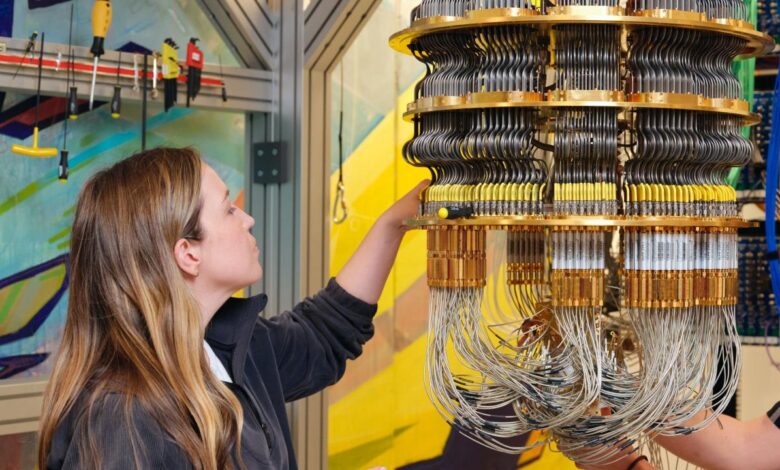
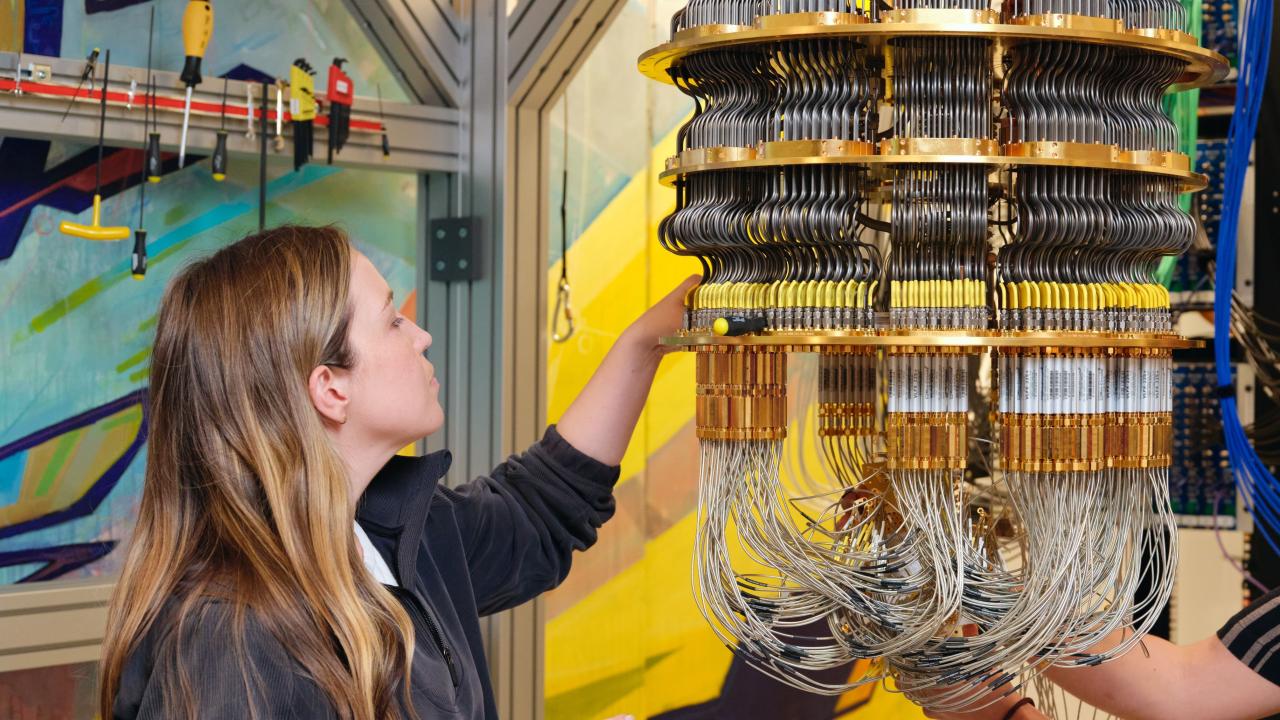
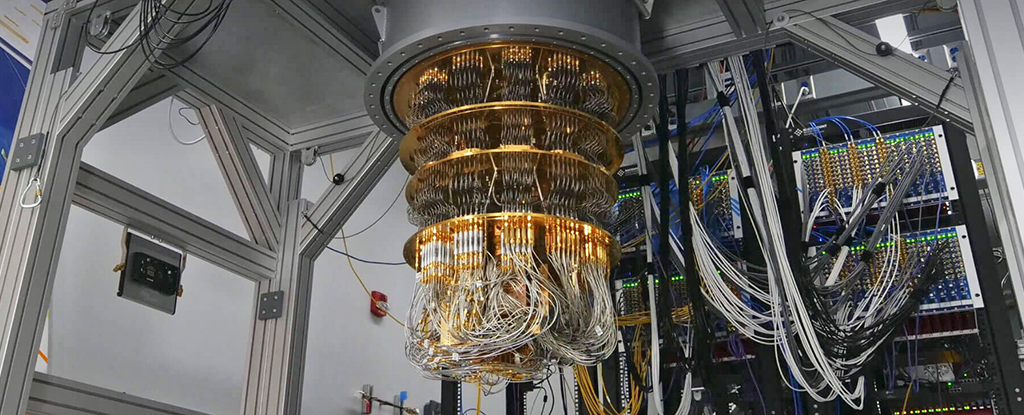
IBM has been a driving force in making quantum computing accessible via the cloud. Their approach uses superconducting qubits, tiny circuits cooled to near absolute zero (-273°C) that behave as artificial atoms.
* The IBM Condor and Heron Processors: IBM recently unveiled its ‘Condor’ processor with over 1,000 qubits and, more importantly, its ‘Heron’ processor, which features a new architecture that has demonstrated a five-fold reduction in error rates compared to its previous flagship. This focus on quality over pure quantity is what led to their recent Quantum Volume record.
B. Google Quantum AI: Pursuing Quantum Supremacy
Google made headlines in 2019 by claiming “quantum supremacy” with its 53-qubit Sycamore processor, which performed a specific calculation in 200 seconds that would take the world’s fastest supercomputer 10,000 years.
* The Roadmap to a Useful Quantum Computer: Google’s team is now focused on building larger, error-corrected processors. Their recent records involve demonstrating the viability of their quantum error correction techniques, showing that by grouping multiple physical qubits into one “logical qubit,” they can detect and correct errors in real-time, a vital step toward building a fault-tolerant quantum computer.
C. IonQ and Honeywell (Now Quantinuum): The Trapped-Ion Approach
Companies like IonQ and Quantinuum use a different technique: trapped-ion qubits. Here, individual atoms (ions) are suspended in a vacuum by electromagnetic fields and manipulated with lasers.
* Advantages of Trapped-Ions: This method naturally produces qubits with exceptionally low error rates and long coherence times. They also benefit from native all-to-all connectivity, meaning any qubit can directly interact with any other qubit, simplifying algorithm design. Quantinuum has recently set records for the highest Quantum Volume, directly competing with and often surpassing the superconducting approach.
D. Beyond the Lab: The Practical Applications Unleashed
A quantum computer is not a faster version of your laptop; it is a different tool for a different class of problems. This new record brings us closer to solving real-world challenges that are currently intractable.
A. Drug Discovery and Materials Science
Simulating molecular interactions is incredibly difficult for classical computers. Quantum computers can model complex molecules atom-by-atom, revolutionizing the process.
* Example: They could help design new pharmaceuticals by precisely simulating how a drug candidate binds to a protein target, or create novel materials for more efficient batteries, solar panels, and superconductors.
B. Optimization of Complex Global Systems
Many of the world’s most complex challenges are optimization problems.
* Examples: A quantum computer could optimize global logistics and supply chains to minimize fuel consumption, find the most efficient routes for autonomous vehicle fleets in a city in real-time, or revolutionize financial portfolio management by modeling market risk with unprecedented complexity.
C. Cryptography and Cybersecurity
This is a double-edged sword. A powerful, fault-tolerant quantum computer could break much of the modern encryption that secures our online data and financial transactions (a threat known as “Q-Day”).
* The Solution: This very threat is driving the field of post-quantum cryptography—developing new encryption algorithms that are secure against attacks from both classical and quantum computers. The recent record underscores the urgency of this global cybersecurity transition.
D. Artificial Intelligence and Machine Learning
Quantum computing has the potential to supercharge AI by exponentially speeding up the training of machine learning models, especially for uncovering subtle patterns in massive, complex datasets that are invisible to classical algorithms.
E. The Road Ahead: Challenges and the Path to Fault Tolerance
Despite this monumental record, we are still in the Noisy Intermediate-Scale Quantum (NISQ) era. The path to a fully fault-tolerant quantum computer is long and paved with immense challenges.
A. The Daunting Challenge of Decoherence and Error Correction
Qubits are extremely fragile. Any minor environmental disturbance—a stray photon, a vibration, or a temperature fluctuation—can cause decoherence, collapsing the superposition and introducing errors. Building a practical quantum computer requires sophisticated Quantum Error Correction (QEC). This involves using hundreds or even thousands of “physical” qubits to create a single, stable “logical” qubit that is resilient to errors. The recent demonstrations of dynamic circuits are a critical first step toward this goal.
B. The Cryogenic and Control Infrastructure
Quantum processors, especially superconducting ones, require immense and complex infrastructure. They must be housed in ultra-high vacuum dilution refrigerators that are colder than outer space. Furthermore, the systems for controlling the qubits and reading their results are currently the size of a room. A major engineering challenge is the miniaturization and integration of this control electronics.
C. Algorithm and Software Development
Hardware is nothing without software. The ecosystem of quantum algorithms is still in its infancy. Researchers and companies are actively developing programming frameworks like Qiskit (IBM) and Cirq (Google) to make it easier for developers to write quantum code and discover new, useful applications for this nascent technology.
Conclusion: A Record That Echoes Into the Future
The recent shattering of the quantum computing record is far more than a technical footnote; it is a resonant signal from the future of technology. It proves that the fundamental obstacles to building powerful quantum machines are not insurmountable. We are moving from the realm of pure theoretical physics into an era of tangible engineering progress. While a universal, fault-tolerant quantum computer may still be a decade or more away, each successive breakthrough like this one shortens that timeline and expands the horizon of what is possible.
The implications cascade across every sector—from designing life-saving drugs and combating climate change with new materials to securing our digital future and unlocking new forms of artificial intelligence. This record is a testament to human ingenuity and a powerful reminder that the next computational revolution is not just coming; it is being built, qubit by qubit, in laboratories today. For businesses, researchers, and policymakers, the message is clear: the quantum future is no longer an abstraction. It is an imminent reality that demands our attention, investment, and preparation.