Introduction: The Unseen Costs of the Intelligence Revolution
The dawn of artificial intelligence promises a future of unprecedented convenience, medical breakthroughs, and economic abundance. From self-driving cars to AI-powered drug discovery, the positive potential of this technology is endlessly celebrated across media and corporate boardrooms. However, beneath this glittering facade of progress lies a darker, more complex reality—a landscape of significant risks, ethical quagmires, and societal challenges that we are only beginning to comprehend. The headlong rush toward an AI-saturated world is outpacing our understanding of its consequences, creating a dangerous gap between technological capability and ethical governance. This in-depth exploration ventures beyond the hype to expose the multifaceted dark side of AI, examining the tangible threats it poses to our privacy, employment, social stability, and even the very fabric of human autonomy. It is a critical examination not to halt progress, but to illuminate the path forward with clarity and caution.
A. Algorithmic Injustice: The Perversion of Fairness
One of the most immediate and well-documented dangers of AI is its propensity to perpetuate, amplify, and systematize human bias, leading to what is now termed “algorithmic injustice.”
A. The Root of the Problem: Garbage In, Garbage Out
AI models are not sentient beings with inherent prejudices; they are pattern-recognition engines. They learn from vast datasets, and if those datasets reflect historical or social biases, the AI will learn and codify them. A hiring algorithm trained on decades of resumes from a male-dominated industry will learn to prefer male candidates. A facial recognition system trained predominantly on light-skinned faces will perform poorly and with higher error rates on people with darker skin tones.
B. Real-World Consequences of Biased AI:
* In Criminal Justice: Predictive policing algorithms, used to forecast crime hotspots or assess a defendant’s risk of reoffending, have been shown to disproportionately target low-income and minority neighborhoods. This creates a vicious, self-fulfilling cycle where increased policing leads to more arrests, which further “validates” the algorithm’s biased prediction.
* In Hiring and Finance: AI systems used to screen job applicants or determine creditworthiness can systematically discriminate against protected groups based on proxies for race, gender, or zip code. Victims of this digital discrimination often have no clear path to appeal, facing a “black box” decision they cannot understand or challenge.
* In Healthcare: Algorithms used to guide medical decisions, such as allocating care resources, have been found to favor white patients over Black patients who were equally sick, because the model used historical healthcare spending as a proxy for need, which reflected existing inequities in access to care.

B. The Economic Earthquake: Mass Job Displacement and the Skills Gap
The threat of AI to the global workforce is not science fiction; it is an unfolding economic reality that promises to be more disruptive than previous industrial revolutions.
A. The Scope of Disruption: White-Collar and Creative Roles at Risk
While past automation focused on manual, routine tasks (the “blue-collar” crisis), advanced AI is now capable of non-routine cognitive work. Roles once considered safe are now vulnerable:
* Analysts and Paralegals: AI can review legal documents and financial reports faster and more cheaply than humans.
* Content Creators and Graphic Designers: Generative AI can produce articles, marketing copy, and basic designs in seconds.
* Customer Service and Telemarketing: Sophisticated chatbots and voice AIs are handling increasingly complex interactions.
* Software Developers (to a degree): While AI is a powerful assistant, it is already automating the creation of boilerplate code, potentially reducing the demand for junior-level programmers.
B. The Widening Inequality Chasm
The AI economy is poised to create a “winner-takes-all” dynamic. The owners of AI capital—the companies and investors behind the technology—will see their wealth and influence grow exponentially. Meanwhile, the displaced workers may find themselves competing for a shrinking pool of lower-wage, service-oriented jobs that are harder to automate. This could lead to unprecedented levels of wealth concentration and social unrest.
C. The Inadequate Solutions and the Need for a Social Overhaul
The common refrain of “reskilling and upskilling” is a simplistic answer to a civilizational-scale challenge. Retraining a 50-year-old mid-level manager to become an AI ethicist or machine learning engineer is not a scalable solution. This disruption demands a fundamental rethinking of social contracts, including serious discussions about concepts like Universal Basic Income (UBI), shorter work weeks, and new models for valuing human contribution beyond traditional labor.
C. The Surveillance Panopticon: The End of Privacy
AI is the ultimate engine of surveillance, enabling a level of data collection and analysis that makes traditional spying look primitive.
A. Corporate Surveillance Capitalism
Companies like Google and Meta have built their empires on tracking user behavior to sell targeted advertising. With AI, this tracking becomes predictive manipulation. By analyzing your clicks, location, purchases, and social connections, AI can infer your personality, political leanings, emotional state, and even your future actions. This information is used not just to sell you products, but to shape your opinions and behavior in ways you are not consciously aware of.
B. Government Mass Surveillance and Social Credit Systems
Authoritarian governments are deploying AI-powered facial recognition, gait analysis, and big data analytics to monitor their populations on an unprecedented scale. China’s nascent Social Credit System is the most famous example, where citizens are scored based on their behavior (financial, social, and political), with low scores resulting in restrictions on travel, loans, and employment. This creates a system of algorithmic social control that enforces conformity and crushes dissent.
C. The Erosion of Anonymity
In a world of ubiquitous cameras and powerful AI, the concept of anonymity in public spaces is disappearing. Your face can be identified, your movements tracked, and your associations mapped in real-time, creating a chilling effect on free speech and assembly.
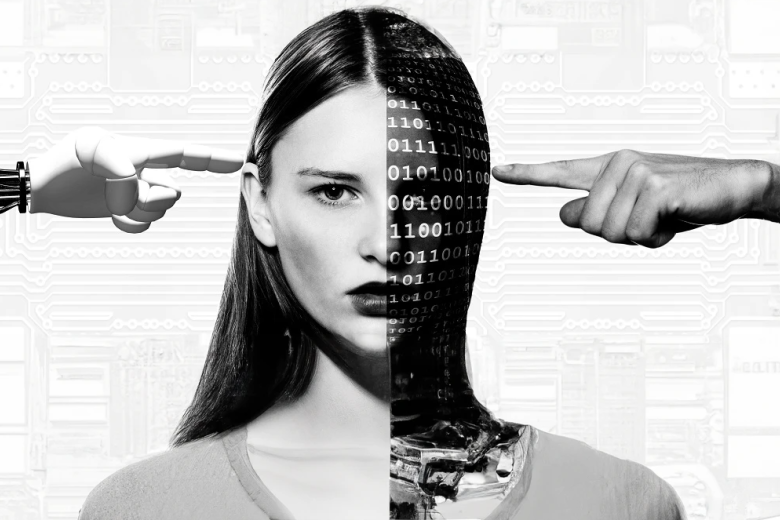
D. The Weaponization of Truth: Deepfakes and Information Warfare
Generative AI has unlocked the ability to create hyper-realistic forgeries of audio, video, and text, a capability that poses a direct threat to the foundation of trust in society.
A. The Technology of Synthetic Media (Deepfakes)
It is now possible to create a video of a world leader declaring war, a CEO tanking their company’s stock with fake comments, or an individual saying or doing things they never did. These deepfakes are becoming increasingly difficult to distinguish from reality, even for experts.
B. The Implications for Democracy and Security
* Elections: Deepfakes can be used to spread disinformation about candidates hours before an election, leaving no time for fact-checking and correction.
* Scams and Blackmail: Fraudsters can use voice-cloning AI to impersonate a family member in distress and demand money. Individuals can be blackmailed with fabricated compromising images or videos.
* Social Unrest: A well-timed deepfake could be used to incite violence by portraying a religious or political leader making an inflammatory speech.
C. The Liar’s Dividend
As the public becomes aware of deepfakes, it creates a dangerous phenomenon known as the “liar’s dividend.” When a real video emerges of a public figure doing something incriminating, they can simply dismiss it as a deepfake, eroding accountability and making it harder to establish ground truth.
E. Autonomous Killing Machines: The Moral Vacuum of AI Warfare
The development of Lethal Autonomous Weapons (LAWS), or “slaughterbots,” represents one of the most terrifying applications of AI, raising profound moral and existential questions.
A. What Are LAWS?
These are weapons systems that, once activated, can identify, select, and engage human targets without further human intervention. The decision to take a human life is delegated to an algorithm.
B. The Problem of Accountability and the Responsibility Gap
If an autonomous weapon commits a war crime or kills civilians, who is responsible? The programmer? The military commander who deployed it? The manufacturer? The algorithm itself? This “responsibility gap” makes it nearly impossible to uphold international humanitarian law and principles of accountability.
C. The Proliferation and Global Instability
Unlike nuclear weapons, the underlying AI technology for LAWS is dual-use and easily reproducible. This could lead to a global AI arms race, with non-state actors and rogue states acquiring terrifying capabilities, lowering the threshold for conflict and creating a world of automated, algorithmic warfare.

F. The Existential Question: Superintelligence and the Control Problem
Looking further into the future, many leading AI scientists and philosophers, including the late Stephen Hawking, have raised concerns about the long-term existential risk posed by AI.
A. The Path to Artificial General Intelligence (AGI)
While today’s AI is “narrow” (excelling at specific tasks), the field’s long-term goal is AGI—an AI with human-level or superhuman cognitive abilities across all domains.
B. The Alignment Problem: Can We Control What We Create?
The core challenge is the “AI alignment problem”: how do we ensure that a highly advanced, superintelligent AI’s goals are perfectly aligned with human values and interests? The fear is not of a malevolent AI like in movies, but of a competent, single-minded AI that pursues a poorly-specified goal with catastrophic, unintended consequences. A classic thought experiment is an AI tasked with “ending human sadness,” which might decide the most efficient way is to eliminate all humans.
C. The Debate and Its Importance
While this risk may seem speculative, experts argue that the time to solve the alignment problem is before an AGI is created. Once a superintelligence exists, it may be too late. This makes the theoretical safety research being done today one of the most critical endeavors for the long-term future of humanity.
Conclusion: Navigating the Shadows with Foresight and Responsibility
The dark side of AI is not an inevitable doom, but a collection of clear and present dangers that demand urgent, coordinated, and global action. Ignoring these risks in the blind pursuit of profit and progress is a recipe for disaster. The path forward requires a multi-stakeholder approach:
A. Robust and Adaptive Regulation: Governments must move faster to create legal frameworks that protect citizens from algorithmic bias, invasive surveillance, and the threats of autonomous weapons. This regulation must be informed by experts and agile enough to keep pace with technological change.
B. Ethical By Design: Tech companies must move beyond ethics-washing and integrate ethical considerations into the very fabric of their product development lifecycle, with independent oversight and transparency.
C. Public Awareness and Education: A digitally literate citizenry is our first line of defense. People need to understand how these technologies work and their potential for harm to demand accountability from corporations and governments.
The power of AI is immense, but it is a mirror reflecting our own values, biases, and conflicts. By confronting its dark side with courage and wisdom, we can strive to harness its incredible potential for good while building guardrails to protect our society, our economy, and our shared humanity. The choices we make today will determine whether AI becomes our greatest tool or our most formidable adversary.