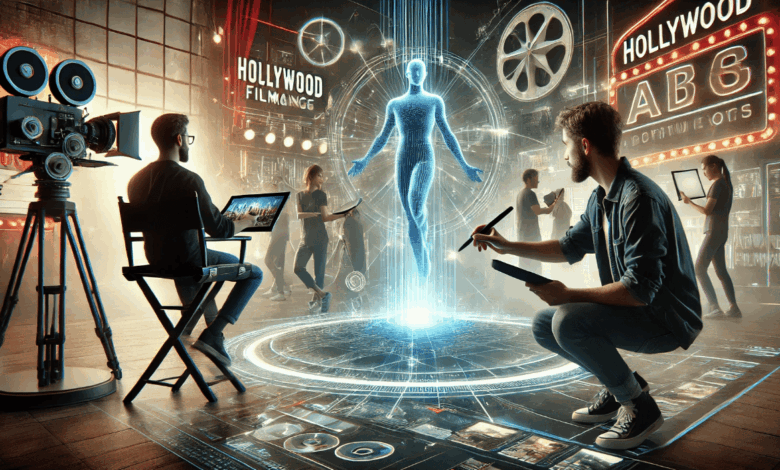
For over a century, Hollywood has been the global epicenter of storytelling, a dream factory built on the unique and irreplaceable talents of writers, actors, directors, and visual artists. Its magic was considered uniquely human, immune to the automation that transformed other sectors. This illusion has now been shattered. The film and television industry is confronting what many within it describe as an “AI nightmare”—a rapid, disruptive technological revolution that threatens to fundamentally reshape every stage of production, from the first draft of a script to the final visual effects on screen. This is not a distant sci-fi plot; it is a present-day reality fueling labor strikes, existential fear, and a fierce debate about the very soul of creativity. However, within this perceived nightmare also lies a potential renaissance of unprecedented creative tools and economic models. The industry now stands at a crossroads, forced to navigate a path that balances the terrifying power of automation with the enduring value of human artistry.
A. The Frontlines of Disruption: How AI is Infiltrating Hollywood
Artificial intelligence is no longer a futuristic concept in entertainment; it is a practical tool being deployed across the production pipeline, often with controversial implications.
A.1. The Writing Room: From Script Doctors to Algorithmic Storytellers
The foundational art of screenwriting is facing its most significant challenge since the advent of sound.
-
AI-Powered Script Analysis: Studios are already using AI tools to analyze screenplays for box office potential, assessing elements like plot structure, character arcs, and dialogue against databases of historical hits and misses. This reduces creative decisions to data-driven metrics, potentially homogenizing storytelling and sidelining original, risky ideas.
-
Generative Scriptwriting: Large Language Models (LLMs) like GPT-4 can generate scripts, dialogue, and even entire scenes based on simple prompts. While current outputs often lack depth and nuance, they are rapidly improving. The threat is not that AI will instantly write an award-winning film, but that it can be used to generate first drafts, sequels, or spin-offs at near-zero cost, devaluing the labor of human writers and turning them into mere editors of algorithmic content.
-
The “Writers’ Room of One”: A terrifying prospect for the collaborative writing process is a future where a single executive uses AI to generate and refine scripts, eliminating the need for a traditional, salaried writers’ room and its diverse perspectives.
A.2. The Performance Capture: The Digital Replication of Actors
The craft of acting is being redefined by the ability to digitally capture, replicate, and manipulate human performance.
-
Digital Doubles and De-Aging: Technologies like MetaHuman Creator can generate photorealistic digital humans. When combined with performance capture, this allows for the creation of “digital doubles” that can perform stunts or be placed in dangerous scenes without the actor being present. While useful, this also means an actor’s likeness can be used in perpetuity, long after their contract has ended, raising profound questions of consent and compensation.
-
The “Synthetic Performer”: The most dystopian fear is the rise of entirely AI-generated actors. A studio could create a synthetic star, owned entirely by the corporation, who never ages, demands no salary, and is free from scandal. This could render countless working actors obsolete and create an uncanny valley of artificial celebrities.
-
The Legal Battle for Likeness: The 2023 SAG-AFTRA strike was a landmark moment, with actors fighting for and winning protections against the uncontrolled use of their digital likenesses. The new agreements mandate consent and compensation for the use of AI-generated replicas, setting a crucial precedent for the future.
A.3. The Post-Production Revolution: VFX, Editing, and Sound
The most immediate and widespread adoption of AI is occurring behind the scenes, in the highly technical and labor-intensive fields of post-production.
-
AI-Assisted Visual Effects (VFX): AI tools can now rotoscope (isolate objects from a background), remove unwanted objects, and even generate complex CGI environments in a fraction of the time and cost of traditional methods. This democratizes high-end VFX for smaller productions but threatens the jobs of highly skilled artists.
-
Generative Video and Deepfakes: Tools like OpenAI’s Sora and other text-to-video models can generate short, high-quality video clips from a simple text description. While currently limited, this technology points to a future where directors can pre-visualize scenes or even generate stock footage instantly. The dark side is the proliferation of deepfakes, which can be used for misinformation or to create non-consensual explicit content featuring celebrities.
-
Automated Editing and Sound Design: AI can analyze hours of footage and automatically assemble a rough cut based on the script or directorial style. Similarly, AI can generate original soundtracks and sound effects tailored to the mood of a scene, challenging the roles of editors and composers.
B. The Economic and Labor Earthquake
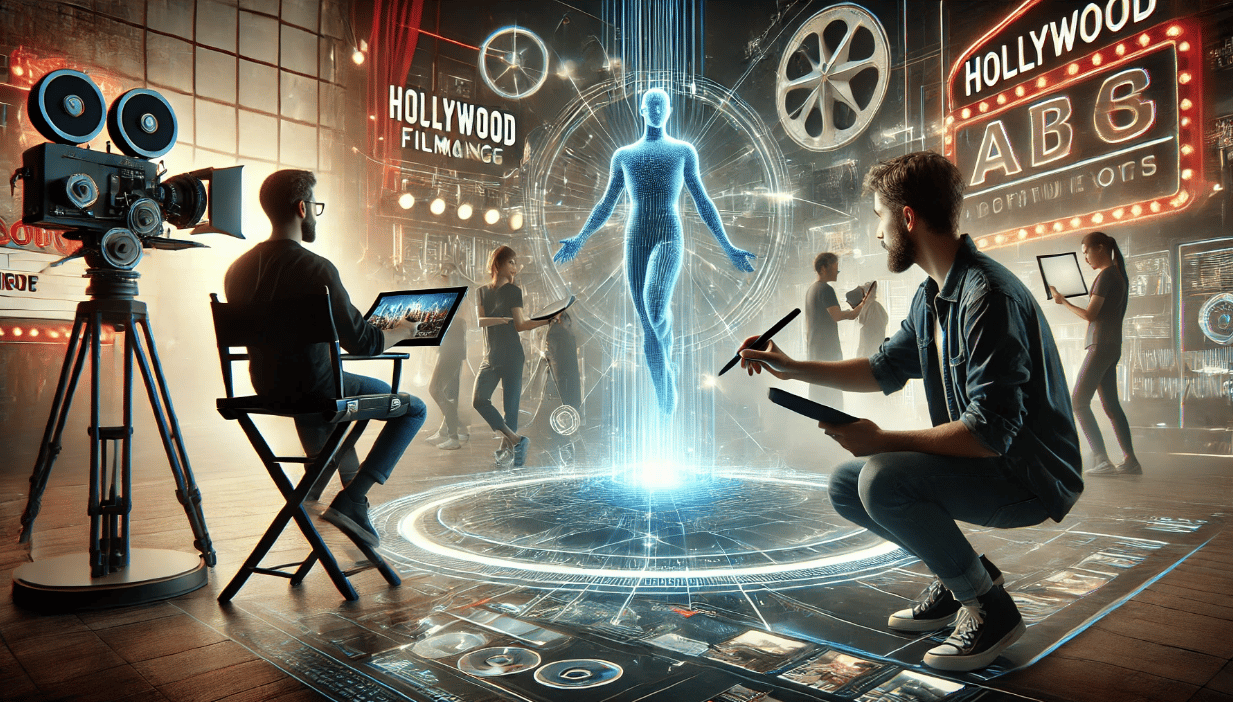
The integration of AI is not just a technological shift; it is triggering a seismic economic realignment that is pitting studios against the very creators who power them.
B.1. The Drive for “Efficiency” and Cost-Cutting
For studio executives and streamers facing profitability pressures, AI represents the ultimate tool for reducing the largest line items in a production budget: human labor.
-
The Bottom-Line Argument: Why pay a team of ten writers for six months when an AI can produce a draft in an afternoon for the cost of a software subscription? Why hire a large team of VFX artists for a year when a smaller team augmented by AI can do the job in three months?
-
The Proliferation of Content: AI can enable the mass production of “good enough” content to fill the insatiable maw of streaming services. This could lead to a flood of algorithmically-generated, low-cost media that drowns out more expensive, artist-driven projects.
B.2. The 2023 Labor Strikes: A Battle for the Future
The dual Writers Guild of America (WGA) and SAG-AFTRA strikes were a historic response to the AI threat, representing the first major industrial action against AI-driven displacement.
-
Core Demands and Victories: The unions fought for and secured crucial protections, including:
A. Regulation of AI in Writing: The WGA agreement stipulates that AI cannot be used to write or rewrite literary material, and AI-generated content cannot be considered source material, protecting writers’ credits and compensation.
B. Consent and Compensation for Actors: SAG-AFTRA secured a framework that requires informed consent and fair pay for the creation and use of a digital replica, preventing studios from scanning background actors for a day’s pay and using their likeness forever. -
An Unfinished War: While the strikes established critical guardrails, they are merely the first chapter in a long-term negotiation. The technology will continue to evolve, requiring constant vigilance and adaptation from labor unions.
C. The Creative Paradox: Tool vs. Tyrant
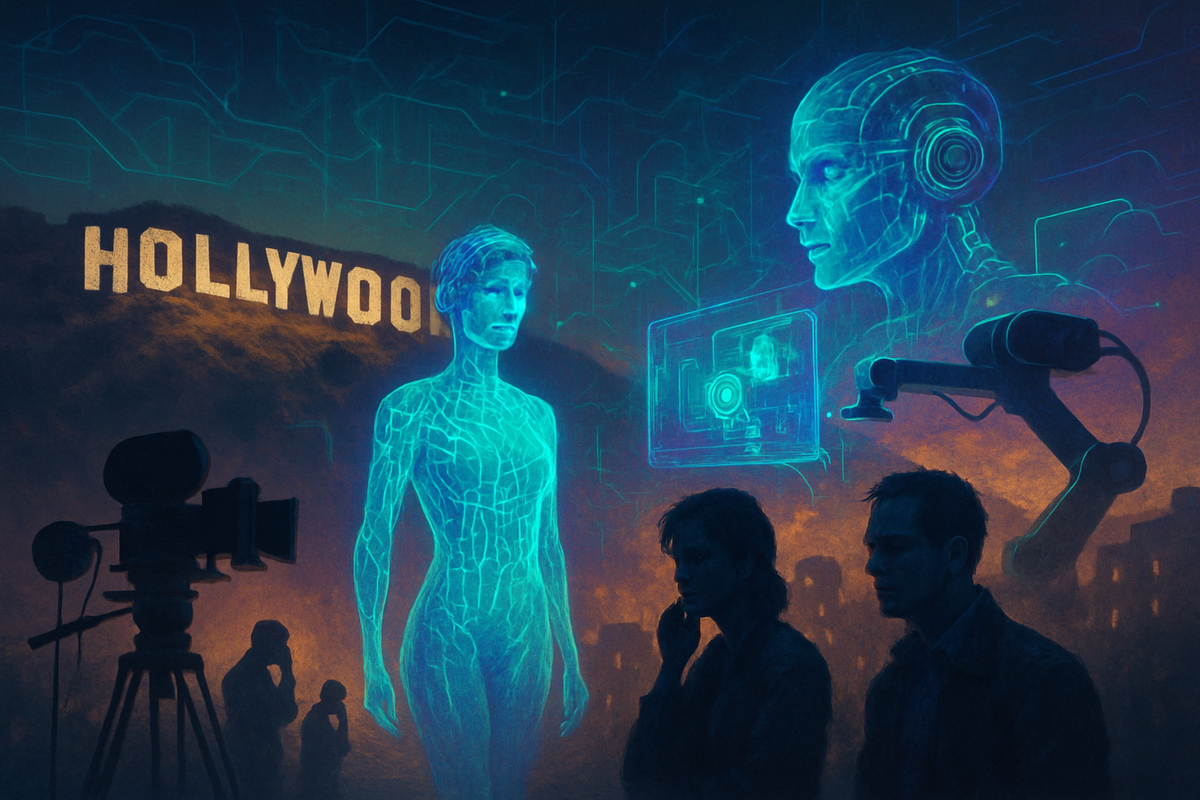
Despite the justifiable fear, many forward-thinking creators see AI not as a job-stealer, but as the most powerful creative tool ever invented.
C.1. The Democratization of High-End Filmmaking
AI can lower the barriers to entry, allowing visionary storytellers without massive budgets to realize their dreams.
-
The Indie Filmmaker’s Arsenal: An independent director can use AI to generate concept art, storyboards, and even temporary visual effects, allowing them to pitch a project with a visual fidelity that was previously only available to major studios.
-
The Empowerment of New Voices: Filmmakers from underrepresented backgrounds, who have historically been shut out of the traditional studio system, can use these tools to create and share their stories, potentially leading to a more diverse and vibrant cinematic landscape.
C.2. The Augmentation of Human Creativity
The most likely future is one of collaboration, not replacement—a partnership between human intuition and machine execution.
-
The Director as “Creative Prompt Engineer”: A director could use an AI to rapidly generate hundreds of visual variations for a costume or a set design, then curate and refine the best options, accelerating the pre-production process exponentially.
-
Personalized and Interactive Stories: AI could enable new forms of narrative, such as interactive films where the story adapts in real-time based on audience reactions, or personalized versions of a film where certain elements are tailored to individual viewer preferences.

D. Navigating the Uncharted Future: Challenges and Solutions
The path forward for Hollywood is fraught with ethical, legal, and artistic challenges that must be addressed proactively.
D.1. The Intellectual Property and Copyright Crisis
The legal system is completely unprepared for the questions posed by generative AI.
-
The “Training Data” Problem: The AI models disrupting Hollywood were trained on vast datasets of existing films, scripts, and images, almost all of which are copyrighted. A flurry of lawsuits from creators and media companies alleges that this constitutes mass copyright infringement. The outcome of these cases will determine whether AI companies need to license training data, which would fundamentally alter their business models.
-
Who Owns an AI-Generated Script? If an executive prompts an AI to “write a sci-fi movie in the style of James Cameron,” who owns the copyright? The user? The AI company? Or is it not copyrightable at all? These are unresolved questions with billion-dollar implications.
D.2. The Preservation of the “Human Spark”
At its core, the fear is that AI will strip art of its soul—the imperfect, emotional, and deeply human qualities that make stories resonate.
-
The Risk of Homogenization: If algorithms are trained primarily on past successes, they will inherently be biased toward recreating what has already worked, leading to a creative echo chamber and the death of original thought.
-
The Unquantifiable Element: Great art often comes from pain, joy, and lived experience—things an AI can simulate but never truly feel. The industry must find a way to champion and protect the uniquely human perspective that is the true source of its magic.
Conclusion: A New Genre is Born
Hollywood’s AI nightmare is real, but it is also a catalyst for a necessary and profound transformation. The industry is being forced to shed outdated practices and redefine the value of human creativity in an automated age. The outcome will not be a simple story of human versus machine. The most compelling narratives of the future will likely emerge from a new, collaborative genre—one where artists wield AI as a powerful brush to paint on a digital canvas of infinite possibility. The nightmare will only become reality if the industry allows short-term profit to eclipse long-term artistry. If it can harness this technology responsibly, ensuring that it serves as a tool for augmentation rather than a weapon for replacement, Hollywood may not be facing its end, but the beginning of its most innovative and exciting chapter yet.
Tags: AI in film industry, Hollywood AI disruption, generative AI entertainment, deepfake technology, actors digital rights, AI screenwriting, future of filmmaking, SAG AFTRA AI, visual effects AI, copyright and AI