
For decades, Apple Inc. has stood as a colossus in the technology landscape, consistently redefining entire industries and shaping how humanity interacts with the digital world. From the iconic Macintosh that brought computing to the masses, to the iPod that transformed music, the iPhone that revolutionized communication, and the Apple Watch that pioneered the wearable era, the company’s history is a chronicle of seismic shifts. However, in an age of market saturation and incremental updates, a pressing question dominates the minds of investors, tech enthusiasts, and consumers alike: What is Apple’s Next Big Thing? The answer lies not in a single, isolated product, but in a deeply interconnected strategic vision. Apple’s future is a multi-pronged revolution, weaving together spatial computing, artificial intelligence, health sciences, and automotive ambition into a cohesive ecosystem designed to further embed itself into the fabric of our daily lives.
A. The Spatial Computing Era: Beyond the Smartphone with Vision Pro
The most immediate and tangible glimpse into Apple’s ambitious future is the Apple Vision Pro. This device is not merely a virtual reality headset; it is the foundation for what Apple terms “spatial computing”—a paradigm where the digital and physical worlds coalesce.
A.1. Deconstructing the Vision Pro’s Foundational Technology
The Vision Pro is a technological marvel, and its components signal where all future personal computing is headed.
-
The Micro-OLED Display System: With more pixels than a 4K TV per eye, this technology is crucial for creating a sense of reality and eliminating the “screen door effect” that plagues lesser AR/VR devices. The pursuit of even higher resolution and eventually retinal-level clarity is a guaranteed R&D focus.
-
Advanced Sensor Fusion: A suite of cameras, LiDAR scanners, and TrueDepth sensors continuously map the user’s environment. The next generation of these sensors will be smaller, more power-efficient, and capable of functioning in a wider array of lighting conditions, making the device less obtrusive.
-
The R1 Chip and Beyond: The dedicated R1 chip is responsible for processing input from all these sensors with near-zero latency, preventing the motion sickness common in earlier VR systems. Future iterations will integrate the R1’s functionality with the main processor (M-series) into a single, ultra-efficient chip, reducing size, cost, and power consumption.
A.2. The Evolutionary Roadmap: From Pro to Consumer
The Vision Pro’s high price point positions it as a developer and professional tool. Its evolution will follow a classic Apple playbook.
-
Generation 2: Refinement and Performance: Expect a lighter, more comfortable form factor, improved battery life (potentially with a redesigned external battery), and enhanced passthrough video quality. This version will target creative professionals and enterprise solutions more aggressively.
-
Generation 3 and “Apple Vision Air”: This is the inflection point. By leveraging economies of scale and technological miniaturization, Apple will launch a significantly cheaper, lighter, and more streamlined model—a “Vision Air”—aimed directly at the mass consumer market. This will be the device that truly aims to replace the television, laptop, and tablet for many users.
A.3. The Killer App Ecosystem: What Will Drive Mass Adoption?
Hardware is nothing without software. Apple is betting on several key application domains to justify the device’s existence.
-
Immersive Entertainment: Transforming the living room into a personal cinema is just the start. Live sports events where you feel you are courtside, interactive 3D movies, and immersive gaming are primary drivers.
-
Spatial Productivity: Imagine having multiple expansive, virtual monitors for your Mac, accessible anywhere. Collaborative workspaces where 3D models can be manipulated by teams in real-time, regardless of physical location, will be a game-changer for design, engineering, and architecture.
-
Revolutionizing Communication: FaceTime calls with life-sized, spatial Personas could make traditional video calls feel archaic, fostering a much stronger sense of presence and connection for remote work and family.

B. The Silent Intelligence: Apple’s AI and Machine Learning Ascent
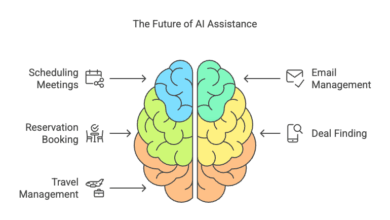
While competitors loudly tout their AI advancements, Apple has pursued a different, arguably more powerful strategy: a practical, privacy-centric, and on-device AI that is seamlessly integrated into its ecosystem.
B.1. The On-Device Advantage: Privacy, Speed, and Reliability
Apple’s focus on processing AI tasks directly on the iPhone, iPad, and Mac via its Neural Engine cores offers distinct benefits.
-
Unmatched User Privacy: Data does not need to be sent to the cloud for processing, meaning personal information, health metrics, and daily habits remain on the user’s device.
-
Instantaneous Response: On-device processing eliminates latency. Features like Live Text, Visual Look Up, and Siri’s on-device speech recognition work instantly, without needing an internet connection.
-
Unprecedented Personalization: The device learns your routine, vocabulary, and preferences in a way that is unique to you, without building a generic profile based on millions of users’ data.
B.2. Projected AI Innovations and Real-World Applications
Apple’s AI will become more contextual, anticipatory, and deeply woven into the operating system.
-
A Truly Intelligent Siri: The next-generation Siri will likely leverage large language models (LLMs) for complex, multi-step tasks and conversational understanding. It will move beyond simple commands to become a proactive digital assistant that can summarize your messages, draft emails in your tone, and cross-reference information across apps with your permission.
-
Advanced Health Predictions: AI will analyze data from the Apple Watch (heart rate, sleep, activity) and potentially new sensors to provide users with personalized health insights and early warnings for conditions like AFib or respiratory issues.
-
Supercharged Creativity: AI tools in creative apps like Final Cut Pro, Logic Pro, and even Photos will become more powerful, offering features like automated video editing, intelligent music composition aids, and enhanced image manipulation that feels magical.
C. The Health Revolution: Transforming the Apple Watch into a Medical Guardian
Apple’s most profound long-term play may be in the healthcare sector. The Apple Watch has already saved countless lives with its fall detection and ECG features. The next phase is to evolve from a fitness tracker to a comprehensive health monitor.
C.1. The Inevitable Introduction of New Biosensors
Research and patents strongly suggest a roadmap filled with advanced health monitoring capabilities.
-
Non-Invasive Glucose Monitoring: This is the holy grail. Successfully developing a sensor that can measure blood glucose levels without drawing blood would be a world-changing breakthrough for diabetics, catapulting Apple into a multi-billion dollar market and solidifying its device as a medical necessity.
-
Blood Pressure Monitoring: Developing a reliable, cuffless method for tracking blood pressure trends would provide invaluable data for managing hypertension.
-
Sleep Apnea Detection: By analyzing sleep patterns, blood oxygen levels, and heart rate variability, the Apple Watch could screen for sleep disorders, encouraging users to seek professional medical advice.
-
Body Temperature Tracking: Already introduced for cyclical tracking, this sensor’s applications will expand for general fever detection and deeper health trend analysis.
C.2. The Broader Health Ecosystem Strategy
Apple’s ambition extends beyond the wrist.
-
Health App as a Centralized Record: The Health app is positioned to become the secure, central repository for an individual’s medical data, with user control over what is shared with healthcare providers.
-
Integration with Medical Institutions: Deeper partnerships with hospitals and clinics for seamless data sharing (with patient consent) could streamline diagnoses and personalized treatment plans.
-
AI-Driven Health Coaching: Combining sensor data with AI, Apple could offer a subscription service that provides personalized fitness regimens, nutritional advice, and mental wellness guidance.
D. The Automotive Frontier: The Reimagined Apple Car
The “Apple Car,” known internally as Project Titan, has been one of the tech world’s most speculated-upon and turbulent projects. While its form has shifted, its strategic importance remains.
D.1. The Pivot to Autonomous Systems
Evidence suggests Apple has scaled back its ambition to build a full-fledged vehicle to compete with Tesla. Instead, the focus has likely shifted to developing a breakthrough autonomous driving system.
-
The Core Technology Play: Apple’s strength is in silicon, software, and sensor fusion—the core components of a self-driving AI. By focusing on creating the “brain” of the autonomous vehicle, Apple could license this technology to established automakers, much like it does with its CarPlay software.
-
The Next-Generation CarPlay: The recently unveiled CarPlay takeover, which integrates with the entire car’s dashboard and instruments, is the first step. This gives Apple a platform and user base, collecting invaluable data on driving habits and in-car user interaction, which feeds back into its autonomous system development.
D.2. The Long-Term Vision: A Fully Integrated Mobility Experience
Even if Apple never manufactures a car, its vision is to own the user experience inside every vehicle.
-
Seamless Ecosystem Integration: Imagine your car automatically adjusting climate control, seat position, and entertainment based on your iPhone profile. Your Vision Pro could become an immersive entertainment system for passengers. Your Health data could alert the car to your stress levels and suggest a calmer route.
-
The Electric and Autonomous Future: When the technology and market are ready, Apple could still launch a vehicle—an electric, fully autonomous “living room on wheels” that serves as the ultimate expression of its integrated hardware, software, and services ecosystem.
Conclusion: The Symphony, Not the Solo
Attempting to identify a single “Next Big Thing” from Apple is to misunderstand its fundamental strategy. The company’s future is not a lone product, but a symphony of interconnected technologies. The Apple Vision Pro establishes a new computing platform. Advanced AI acts as the invisible, intelligent thread connecting all devices. The Apple Watch transforms into a guardian of our personal health. And the automotive project seeks to conquer the next major space we inhabit: our vehicles.
Individually, each of these domains represents a massive market opportunity. Together, they form a powerful, self-reinforcing ecosystem. Data from your Watch informs your Health app on your iPhone, which your AI uses to provide insights, all of which can be seamlessly viewed and interacted with in your spatial computing headset or your future car. This deeply integrated, privacy-focused, and user-experience-driven ecosystem is Apple’s true next big thing. It is a strategic revolution designed to ensure that the next decade of technological innovation, like the last, runs deeply on Apple.
Tags: Apple next big thing, Apple Vision Pro, spatial computing, Apple AI artificial intelligence, Apple Watch health monitoring, Apple Car Project Titan, future technology, Apple ecosystem, tech innovation, Apple rumors